Being honest about it
How these pictures were made
Every picture on this site was generated, and every one says so. None shows a face, a letter or a real client.
Generated, not photographed
This studio is invented, so there is no client's forearm to photograph and no artist's station to point a camera at. Every picture on this site, every tattoo in the portfolio included, was generated from a written description, and each one says so.
About the pictures. Every picture on this site was generated, the tattoos in the portfolio included, and every picture with any part of a person in it says so on the picture. Nobody in them is a client, no face appears anywhere, and no tattoo pictured here contains a letter, a word or a number.
The ten rules the pictures were made under
Each rule is a decision about what a description asks for, and what it leaves out.
Every tattoo pictured is generated
No picture on this site is a photograph of a real tattoo or a real client. Every portfolio piece is captioned as a demonstration, and every picture with skin in it carries a label on the picture saying the person is AI-generated, as New York law asks of an advertisement showing a computer-made person (GBL § 396-b).
No lettering, anywhere
No tattoo pictured contains a letter, a word or a number, and neither does anything else in any picture: no bottle, no label, no screen, no sign and no sheet of flash on a wall. Where a take came back with something that could be read, it was cropped or rendered again.
No named artist, no "in the style of"
Every design was asked for by its structure — its line, its shading, its color and its placement — and never by a person, a school or a famous sheet of flash, so no picture here is a copy of anybody's work.
No face
Every picture of a tattoo is cropped to the limb: a forearm, an upper arm, a calf, an ankle, the top of a shoulder. No face appears anywhere, and no tattoo pictured is on a face, a neck or a hand. The one picture of an ear piercing is taken from behind the head.
Nobody undressed
The tattoos pictured are on skin worn bare in public anyway. The private room is pictured empty.
No blood, no wound
Tattoos are pictured healed, or on the day under a clear film. No needle is pictured going into skin up close.
Gloves and bare hands
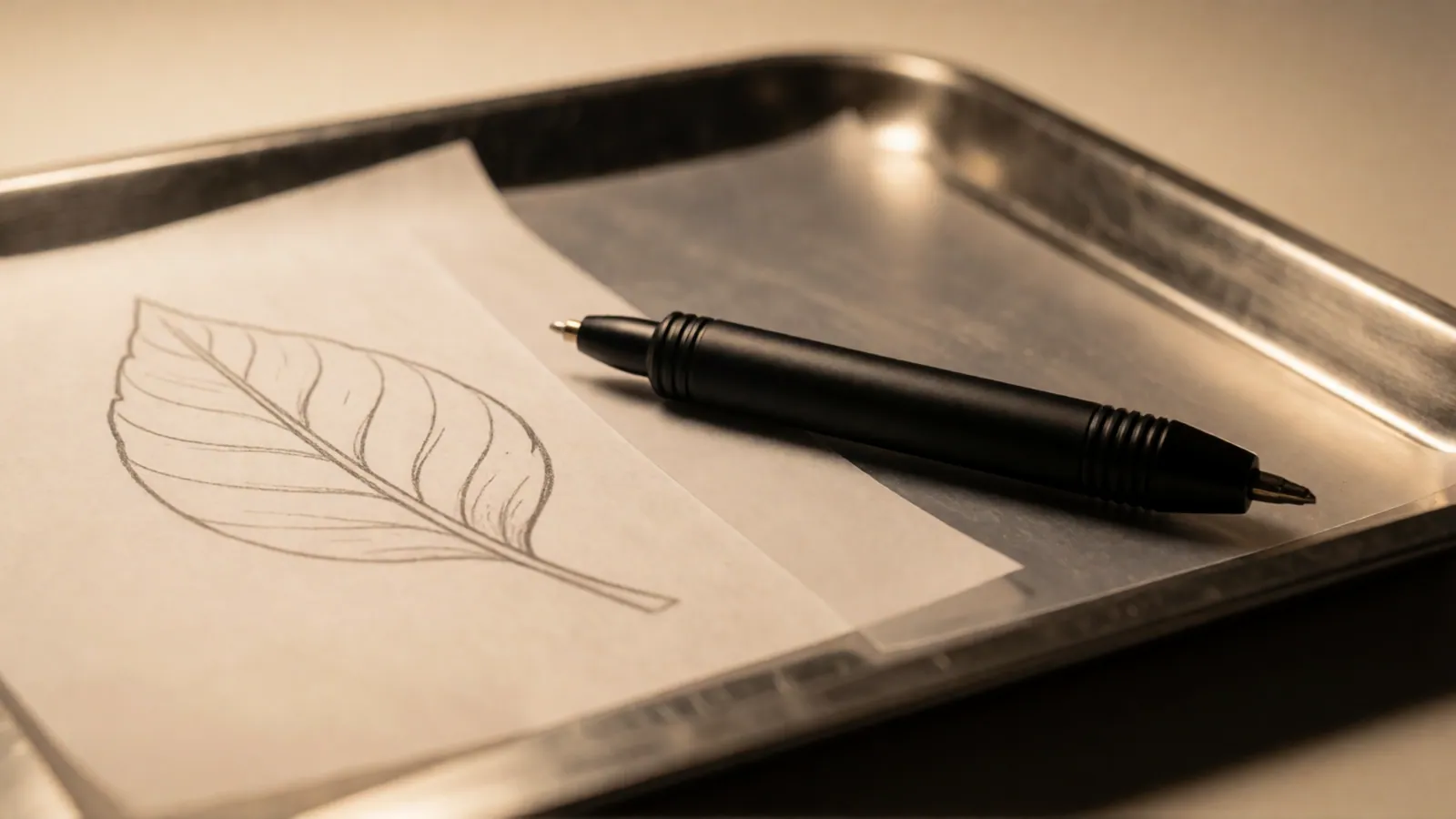
An artist at work appears as two gloved hands. A hand drawing at a desk is bare, with short nails and no ring, watch or bracelet.
No machine's maker, no bottle's label
The tattoo machine in the pictures is a plain black pen with no markings. Ink appears only in small open caps. Nothing pictured has a maker's name on it.
A Queens storefront
The studio in the pictures is a prewar storefront: a pressed-tin ceiling, painted brick with nothing hanging on it, an oak floor. No window in any picture shows a street, a sign or a neighbor, and the one street picture, under the elevated line, carries no sign anybody could read.
Every body different
Skin from deep brown to pale and freckled, because Woodside's is.
What the portfolio leaves out
Some kinds of picture would be more invention than a portfolio can carry. These are the ones this one does without.
- No lettering, script or numbers. Lettering is drawn and tattooed here, and it is the one kind of work this portfolio does not picture: a generated picture of lettering is invented words on invented skin.
- No faces, no necks, no hands with rings, nothing that could identify anybody — and no face tattoos, which are both.
- No design described as "in the style of" a named artist, and no copy of any artist's flash. Every design here is described by its line, its shading and its color.
- No before-and-after pairs. A generated "before" would be a record of a tattoo nobody had.
- No tattoo on the ribs, the chest, the stomach, a hip or a thigh, and nobody undressed: the pieces pictured are on arms, lower legs and the tops of shoulders.
- No fresh wound and no blood. Every piece is pictured healed, or under its clear film on the day.
Two labels, and why they are there
Every portfolio piece carries a caption under it: “Demonstration image, generated for this sample site: not a real tattoo, and not our artists' work.”
A portfolio is the thing a real studio's reputation rests on, so the caption says outright what this one is. A reader should never have to wonder whether a picture here is somebody's tattoo.
Every picture with skin in it also carries a label on the picture itself: “AI-generated image: not a real person, not a client.”
A forearm is a person, and a picture of one that was made by a computer should say so where the eye lands, not in a footnote. A page heading whose picture shows skin says it again, in a line of its own under the heading.
- N.Y. General Business Law § 396-b (opens the source in a new tab) An advertisement that shows a person generated by a computer must say so, conspicuously.
- N.Y. General Business Law § 350 (opens the source in a new tab) False advertising in the conduct of any business is unlawful in New York.
Asked for by structure, never by a name
Every tattoo pictured here was asked for by its line, its shading, its color and its placement, and never by an artist's name, so no picture is a copy of anybody's work.
A real studio built from this design would show real clients' tattoos only with each client's written permission, because a distinctive tattoo can identify its wearer without a face.
Book a consultation
Book a consultation with the artist you want and bring your pictures. There is no charge for it, nothing is paid online, and nothing is tattooed until you have met.